13 January 2020

Community Bike Shops - Part 2

Over the last few years, I have had the opportunity to visit a handful of community bike shops around the United States. This is the second of five posts to show the shops I've seen first-hand, even if I stopped by when they were closed.

Community bike shops (also called community bike projects or co-ops) tend to be non-profit organizations with brick-and-mortar locations that serve the specific bicycling needs of a community. Some have large budgets and paid staff, others are completely volunteer-run. Most shops have a mission statement, which is the best way to learn about what they do and how they operate.

The general model:
  • Reduce the barriers of entry to cycling by taking donated bicycles and parts to be salvaged, rebuilt, and sold at very affordable prices;
  • Empower people with knowledge of how to repair and maintain their own bikes with either classes or DIY shop space and tool libraries;
  • Host events; either for fun, education, or fund-raising; and
  • (From my experience) they also function as safe spaces for people to learn and hang-out.
The shops I've been to are geographically distant from one another, but the similarities are evident. I highly recommend seeking out a co-op bike shop in your neighborhood or the next time you are traveling. Supporting them with a purchase or donation is a great way to share the love of bikes with others.

Photo by Ogden Bike Collective
Ogden, Utah

Mission Statement from their website: 
"The mission of the Bicycle Collective is to promote cycling as an effective and sustainable form of transportation, recreation, and as a cornerstone of a cleaner, healthier, and safer society. The Collective provides refurbished bicycles and educational programs to the community, focusing on children and lower income households."
During a road trip in July 2018, we stopped in Ogden to visit our friend Terry who had moved there from Tacoma a year earlier. Terry worked in the bike industry for many years and jumped in as a volunteer at the Ogden Bike Collective shortly after arriving there. He was even working in the shop the afternoon we rolled into town.


To my surprise, the Ogden Bike Collective occupies its own large building. Owning your own building is the Holy Grail for co-ops. As a former dry-cleaning site, it was obtained in a deal with the City of Ogden after being repossessed. More recently it's needed a new roof and foundation work, but these considerable investments are worth it to maintain this spacious location.


The collective needs the cavernous space to maintain the volume and scale of the Ogden operations. Terry tells me that they currently have around 400 volunteers on their roster who donate anywhere from 1 hour to 500 hours of time annually. Those volunteers are sorting parts, stripping and rebuilding used bikes for sale, and teaching youth volunteers through an Earn-A-Bike program.

They also refurbish bikes for charitable redistribution to the community. They gave away 150 bikes to kids just before the holidays in December 2019 and another 100 kids bikes during the year at smaller events. They also work with other goodwill programs to provide bikes for people in transitional housing situations. Terry says that if they had the means they could easily double the number of bikes they give away as there is always a high need in the community.


Besides selling refurbished bikes and parts, the second most important thing they offer is tools and guidance. "People roll in bikes that are broken and then ride them out fixed," says Terry. "Most are lower income." For folks on a limited budget, it is empowering to give them the skills and space to maintain their bikes, especially if biking is their primary mode of transportation. 


Ogden is just one of four locations of the Bicycle Collective in Utah, but Terry says each shop is unique. Based on volunteer interests and abilities, they have different fundraising events and different shop rides specific to the needs of each community. In Ogden they run a Bike Valet service at city events, taking donations for monitored bike parking at twilight concerts and festivals. They also host an annual Bike Prom. I like that they also have a few freak bikes on-hand and my kids jumped right in to try them out. (That trike above has a seat for a stem and no handlebars!)


Ogden Bike Collective is doing amazing things for their community. Thanks for the tour, Terry! Stay tuned for the next installment as we check out more community bike projects.


08 January 2020

Community Bike Shops - Part 1

Over the last few years, I have had the opportunity to visit a handful of community bike shops around the United States. This is a series of posts to show the ones I've seen first-hand, even if I stopped by when they were closed.

Community bike shops (also called community bike projects or co-ops) tend to be non-profit organizations with brick-and-mortar locations that serve the specific bicycling needs of a community. Some have large budgets and paid staff, others are completely volunteer-run. Most shops have a mission statement, which is the best way to learn about what they do and how they operate.

The general model:
  • Reduce the barriers of entry to cycling by taking donated bicycles and parts to be salvaged, rebuilt, and sold at very affordable prices;
  • Empower people with knowledge of how to repair and maintain their own bikes with either classes or DIY shop space and tool libraries;
  • Most shops host events; either for fun, education, or fund-raising; 
  • From my experience, they also function as safe spaces for people to hang-out.
The shops I've been to are geographically distant from one another, but the similarities are evident. I highly recommend seeking out a co-op bike shop in your neighborhood or the next time you are traveling. Supporting them with a purchase or donation is a great way to share the love of bikes with others.


2nd Cycle Community Cycle Center 
Tacoma, WA

Mission Statement: "To demystify and normalize bike riding as a part of daily life, and realize the bicycle as tool for personal and community empowerment."

Here in Tacoma we are fortunate to have 2nd Cycle, a non-profit community bike shop that has been operating for about 10 years in the Hilltop neighborhood. The folks at 2nd Cycle have really opened my eyes to the added value a co-op shop brings to a community.


They have had to relocate three times over the years, mostly for reasons of growth. They had humble beginnings in a small room off an alley behind a Vietnamese restaurant, but they are currently in their largest space yet with retail, DIY shop space, and warehousing all happening under one roof. They have a large stock of used bikes and parts, as well as new parts and accessories. For a small fee, cyclists can gain access to the shop space, which includes repair stands, tools, reference books, and knowledgeable volunteers and staff who can help guide you through a repair or maintenance project. 


As a shop founded by folks in their late 20s, 2nd Cycle has always had a youthful, vibrant atmosphere. I've watched neighborhood kids grow up with the shop, kids who started just hanging-out there after school and on weekends. They are now trained volunteers who are taking on leadership roles to organize alley cat races and cycling teams, donating their time and energy to the shop. 2nd Cycle regularly offers youth programming including Summer Camps and an Earn-a-Bike program where kids learn the basics of bicycle mechanics and earn the bike they build. They also work with the Pierce County Juvenile Court to offer a diversion program to youth, giving them a chance to learn bike maintenance skills. 


Also, it can't go unsaid that in a male-dominated industry, it's refreshing and awesome to find two women, both certified bike mechanics, wrenching on bikes when you wander in. Shelbi and Emily host a twice-monthly WTF Night, inviting womxn, trans, femme, non-binary folx to come together and use the shop. This is just one example of the inclusivity found on a daily basis at 2nd Cycle.


The DIY empowerment philosophy of 2nd Cycle shines through in their artwork as well. Nearly every poster or t-shirt design has been created in-house by staff members. There is often an art+bike connection in co-op shops and 2nd Cycle is no exception.


There have been many official (and many more unofficial) events hosted by 2nd Cycle over the last decade. The nearly-annual Bike Jump fund-raising event features local legend Gaylen Turner riding his trusty bmx bike through a giant neon sign of his own creation. Other one-off events like the Worksman Criterium have given a breath of vitality to vacant lots in the area.


The shop has also played host to numerous Kidical Mass Tacoma rides. Following a ride through the Hilltop Neighborhood and some playtime at McCarver Park, 100 riders returned to the shop to watch local family rock band Pig Snout! play a massively loud show. Yes, the shop even doubles as a part-time venue for local musicians and fund-raising parties. It's a pretty rad place.


Stay tuned for the next installment as we check out more community bike projects!

08 January 2019

Biking with Tiny Kids

This post is for parents with babies around one year old that are trying to figure out how to bring their precious cargo along for the ride. Obviously, this is just what worked for me and what I was willing to do. Consider your skill level, equipment, road conditions, etc., before attempting any of this at your own risk. In Tacoma, we also have a helmet law that applies to all riders, so you may have to deal with that in your area, too.

I've personally had success with two methods when my kids were tiny. The key was neck strength: kids need to be strong enough to hold their head up firmly when helmeted in order to handle the acceleration/braking force. Keep in mind that the helmet makes their head more top-heavy, so this is a bit different than kids riding without a helmet in a jogger stroller.

My Kid #2 was a slow grower and, early on, couldn't keep her head up comfortably with the helmet in the bike trailer. When she was about 11 months old, I would put her carrier carseat in the bike trailer facing forward. I lap-buckled the carseat in the trailer (Burley d'Lite) and left the carrier handle up like a roll bar. She was then buckled into the 5 point carseat harness as usual and did not wear a helmet. This was good for slow riding (maybe 10mph) with gentle acceleration and braking (barely faster than a jogger stroller). She would often fall asleep and I could slow pedal the neighborhood for an hour on quiet streets. Some additional visuals here.


My Kid #3 was small but very strong. He started riding in a Yepp Mini stem-mounted kid seat at age 8 months, with a helmet. It was awesome: he was perched right in front of me and could see what I could see. I could see him point at things and tell him what they were called. I think this led to him speaking well at an early age. The downside is that those seats are hard to get fitted properly so that the parent rider isn't pedaling knees-out to avoid hitting the seat. They don't fit perfectly on every bike. I purchased my Yepp seat (and a larger one later on) from G & O Family Cyclery in Seattle, which is the go-to place to find a wide assortment of family bikes in the greater Tacoma area. Here is my son on one of his first rides. That Lazer helmet was the smallest I could find and he still needed the hat to make it snug.


There are also cargobikes/boxbikes with boxes or buckets on the front or back that are perfect for carrying small kids or carrier carseats. We had a Madsen "bucket bike" when Kid #2 was 14 months and she sat in it with a lap buckle and helmet, along with her 3yo sis and 3yo cousin. I've seen other parents buckle carseats into the bucket and still have room for another small kid or groceries.


This is certainly not an all-inclusive post, just a summary of my experience with my own children. The one thing I will add pertains to the upfront cost of family bikes, trailers, kid seats, etc. Most of the name-brand gear holds up well and retains its value over time. The bucket bike was a about $1200 new, and we used it 5 days a week for 2 years, then sold it for $600. That was an excellent value to me (both physically, mentally, emotionally!) and just part of our transportation budget during that time.

24 September 2018

Mile after Mile at Swan Creek Park


What a day at Swan Creek Park! We rolled in at sun-up to setup for Century Swan, an attempt at 100 one-mile laps on the paved roads of the Lister Uplands. About ten riders set off around 8:30am. Not all of us we're aiming for 100, but we all needed an early start.


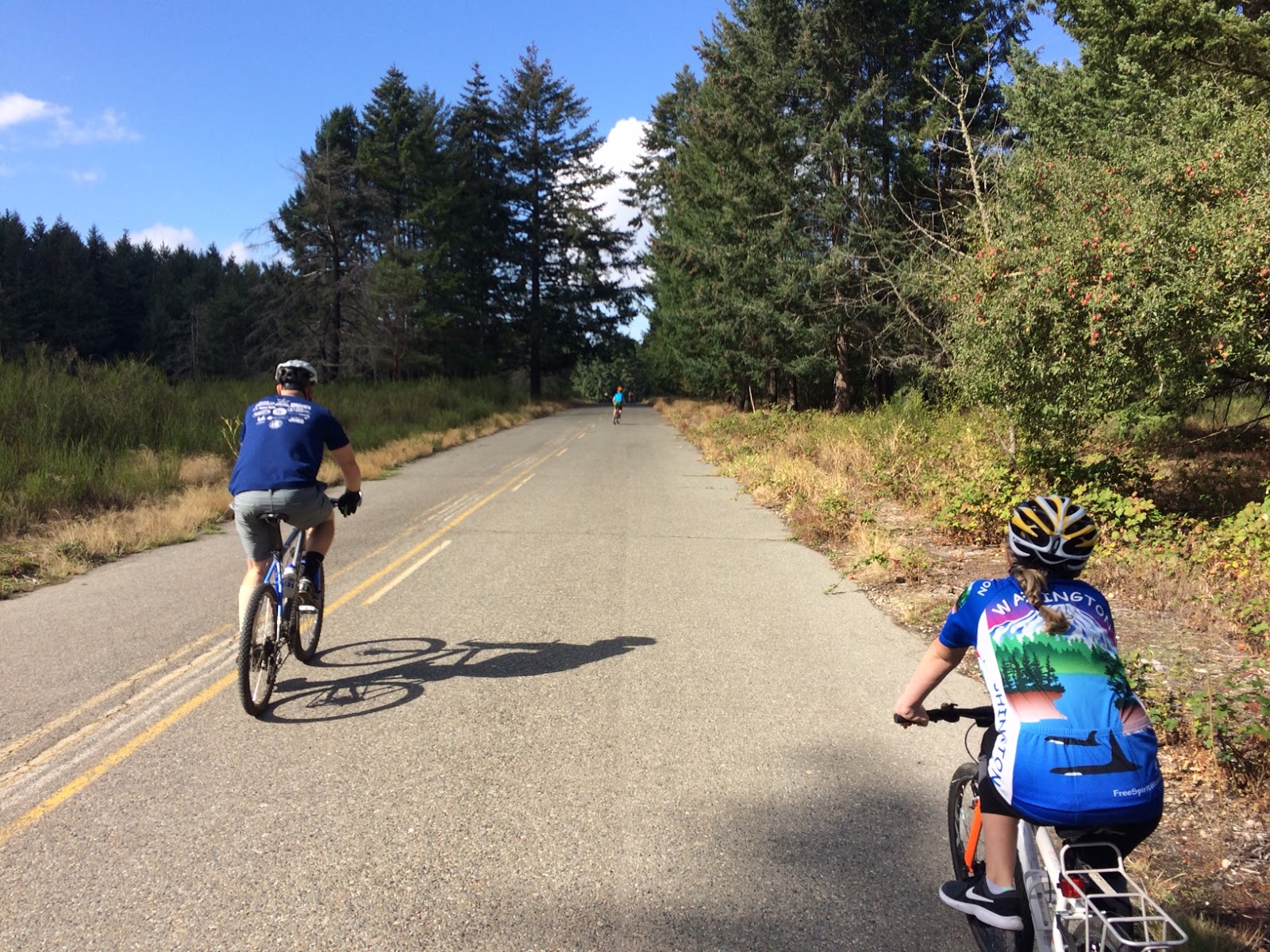
It was pretty cool. There were riders on road bikes, city bikes, kid bikes, mountain bikes, and even one fixed gear bike. One friend came out to take photos and others brought kids and dogs to just hang-out and cheer us on. With the support tent fully stocked, we rolled on into the afternoon with plenty of breaks.


The miles started taking their toll around 2pm. Some folks had reached their goals, some were adding a few bonus miles, and others were trying to dig deep to find a second wind. We were still smiling though! At lap 54, I hooked up the trailer and took my kindergartner for a few slow laps and somehow that helped get my legs ready for another 10 laps on my own.


By 4pm the little kids had all gone home, our fixed gear rider finally threw in the towel at lap 81, and only one person could still pull off the century. Jeremy rode the last two laps on his own and completed the first ever Century Swan! 


It was rad. We each set our own goal, we each set our own pace, but we all still rode together on this tiny course. 

Here are some take-aways:
  1. If you bring a pop-up tent, it's officially a major event.
  2. Daniel can carry that pop-up tent on his road bike handlebars.
  3. Invite everyone.
  4. Figure out who you didn't invite so you can invite them next time.
  5. There will be another Century Swan!


06 August 2018

Century Swan


You all want to ride bikes on Sunday September 23rd? I found a one mile paved loop at Swan Creek Park and I'm going to attempt 100 laps. It's nearly flat, closed to cars, and mostly wooded - the perfect Century Swan! I'll be there at 8am by the pump track with a pop-up tent, chairs, water, tools, tubes, snacks, and hopefully a bunch of you to share the day with. Ride as much or as little as you want - it's not a race - just a reason to show Swan Creek Park some extra love. 


Some Details
Swan Creek Park is the second largest in Tacoma. It's enormous. There was a housing project here in the 1940s, which was razed in the 1950s. The roads remain and the housing blocks are filled with trees. Mountain bike trails have been built in recent years, but the roads are great for folks trying to put in some saddle time without getting too far from their home in Tacoma.

One perimeter lap of the purple area shown above is a nearly perfect mile and there's only 25 feet of elevation gain/drop per lap. There's just enough downhill to coast a bit and just enough uphill that you may want to shift once or twice. 

The best part is that, for now, the park is closed to motorized vehicle traffic. For folks who are new to cycling, especially families that want their youngsters to work on handling and learning some Rules of the Road, this space is perfect.

Access to the park is somewhat limited. You can enter around a gate by the Lister Elementary parking lot or from a paved path at the Swan Creek Community Garden parking lot (porta-potty at this entrance also). The dot on the map above is by the pump track and the mtb trailhead (also a porta-potty location.) You can also reach Swan Creek Park on Pierce Transit Route 41.

Leave a comment if you think you can join me!